
Get an independent valuation report backed by comparable vehicle research and current market data, so you have documentation you can use to challenge a low settlement offer.
When an insurer declares your vehicle a total loss, they calculate what they believe it was worth just before the accident. That figure is often built on limited comparable vehicles and standardized condition adjustments, and it can fall short of what your vehicle would actually sell for in your local market.


The settlement offer is lower than what comparable vehicles are selling for in your area.

The vehicles used to value yours differ in trim, mileage, or condition in ways that affect the result.
Your vehicle was in better condition than the valuation reflects, or recent work was not accounted for.

Factory packages, trim upgrades, or added equipment were left out of the valuation.

The mileage adjustment applied to your vehicle does not reflect its actual reading at the time of loss.

Your policy's appraisal clause is in play and you need independent documentation to support your position.
Insurer valuations are produced quickly and at volume. The four areas below are where errors and conservative assumptions most often reduce the final figure.
The vehicles chosen for comparison may come from a wider geographic area or differ in trim and equipment, which pulls the resulting value away from your local market.
Standardized condition deductions are applied without a physical inspection, so a well-maintained vehicle can be graded the same as an average one.
Local demand affects what a vehicle actually sells for. Valuations that lean on broad regional averages can miss what your market supports.
Previous accident or damage history can trigger deductions that are larger than the effect that history has on real world resale.
Your report documents the fair market value of your vehicle before the loss, supported by comparable vehicle research and clear reasoning you can present to your insurer.
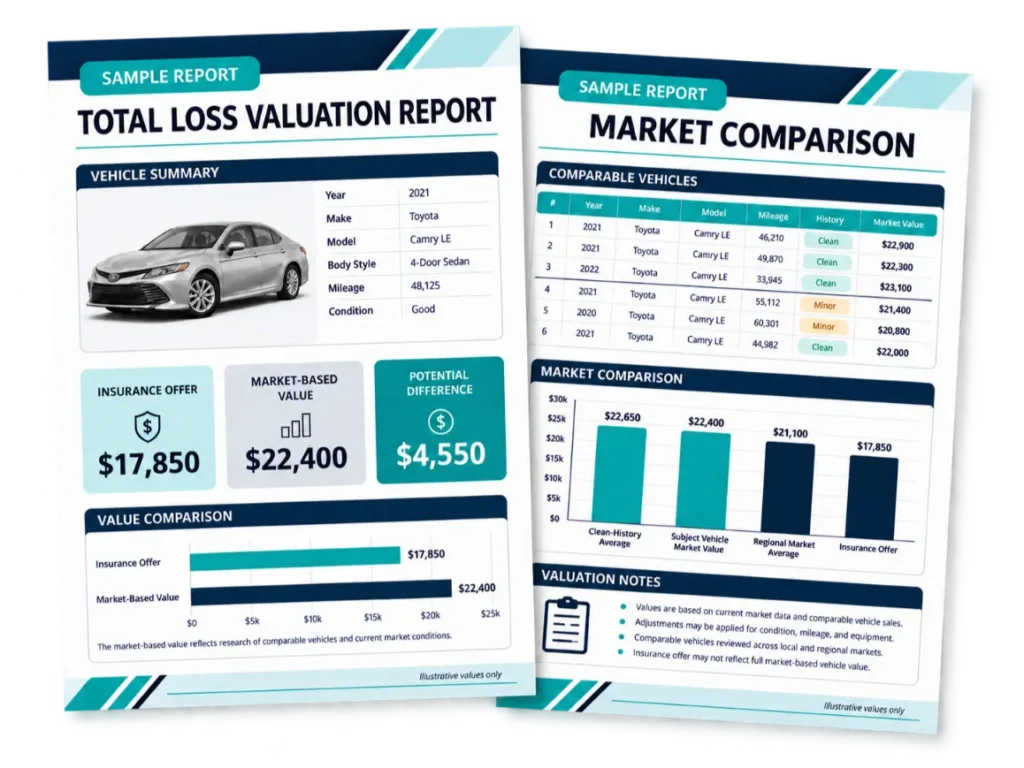
Upload your insurer’s valuation report and receive an independent, professionally prepared report backed by fair market research and comparable vehicles.
Provide the valuation report supplied by your insurance company.
We review comparable vehicles and current fair-market data.
Receive a professionally prepared PDF report within 24–48 hours.
These two reports cover different situations. A total loss valuation applies when your insurer has declared the vehicle a total loss and is settling for its value. A diminished value report applies when your vehicle was repaired and returned to you, but is worth less than it was before the accident because of its accident history.
Diminished value does not apply to a totaled vehicle, because the settlement is already based on the vehicle’s full pre-accident market value. If your vehicle was repaired rather than totaled, the diminished value report is the one you need.
“The report clearly explained how the accident affected my vehicle’s market value and gave me organized documentation to review with my insurance company.”
Our support team is here to help. Get in touch and we’ll respond as soon as possible.